
I should've quit...sooner
Shutting down my startup and why "never give up" is the worst advice that you can give someone


A year ago today, I officially filed the paperwork to shut down Bandwagon, my venture-backed tech company. As a startup founder, I believed that entrepreneurship was a “must be present to win” game. It doesn’t matter what you build or how much you sacrifice…if you aren’t able to keep the lights on long enough for serendipity/timing/luck to happen, you’re just another tombstone in the startup graveyard. Entrepreneurs are taught about the value of grit, and the “never give up” mantra is preached from every incubator to accelerator. But after nearly a decade of building it, raising more than $5M, and securing partners like the NBA, LIFEWTR, and Trioscope, I made the difficult decision to call it quits. Despite wrestling with options and alternatives for months, I wish I had quit sooner.
Maybe a year or two sooner.
At the beginning of this year, I set a goal to read 12 books — one a month. My 12th book of the year was Quit: The Power of Knowing When to Walk Away by Annie Duke. In the book, Duke discusses common cognitive biases such as the “sunk cost fallacy” and “loss aversion” as she weaves in stories of medical doctors, boxers, and entrepreneurs who each struggle with timing. Knowing when to call it quits.
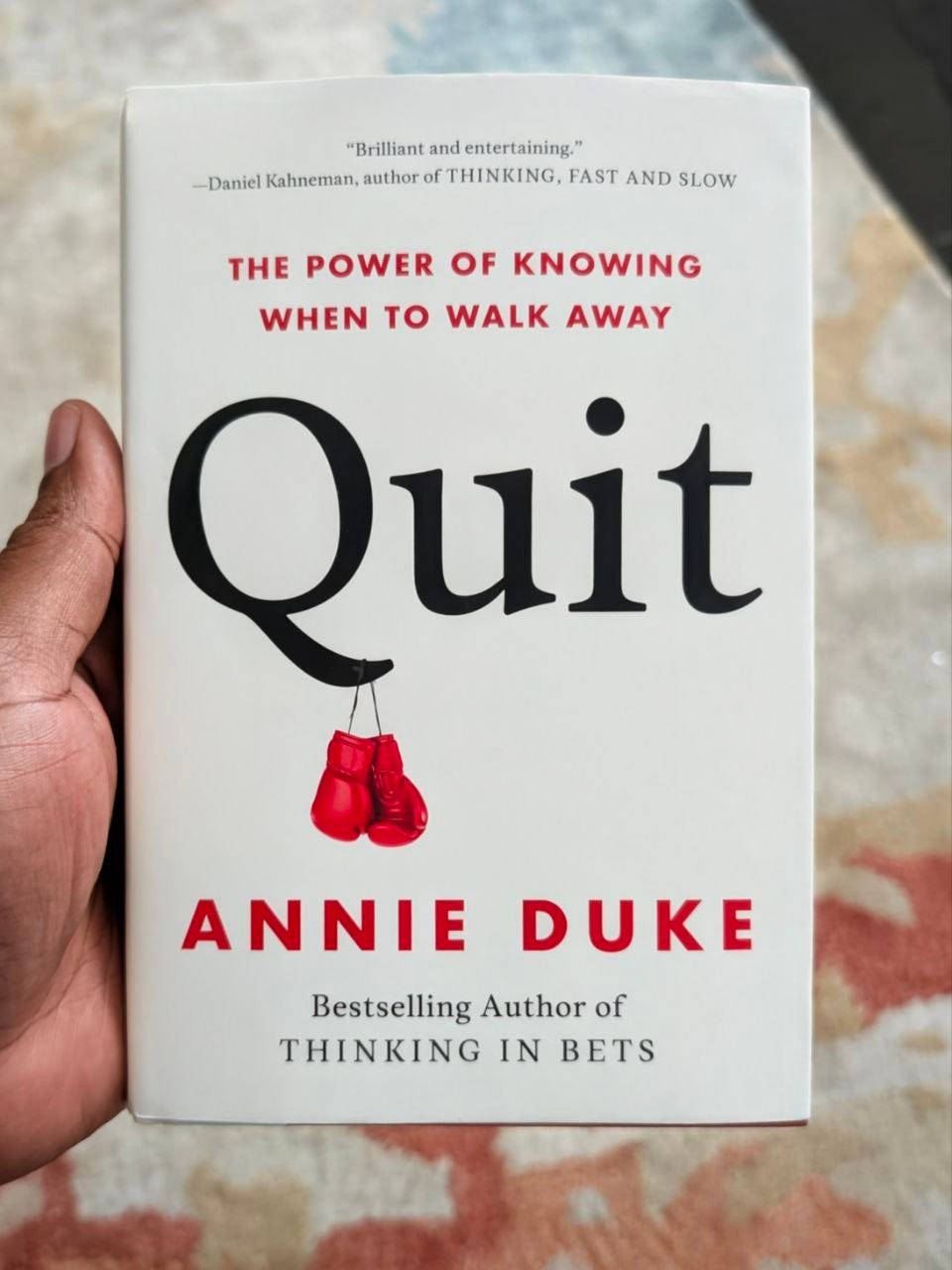
Had I read the book in 2022, when it came out, I likely would’ve had a better lens for evaluating the failed Hail Mary that one of my board members came up with in 2023. If I had set up my own “kill criteria”, I would have been able to reject the plan— a $100k marketing tour after months of dangling a signed term sheet over our heads — the moment that I heard it. But I didn’t. Instead, I was swept up in status quo bias, a cognitive predisposition in favor of one’s current situation, viewing any potential change as a perceived loss, even if the alternative was objectively better. When Annie Duke wrote about the 1996 Mount Everest disaster, which led to the death of Doug Hansen and expedition leader, Rob Hall, she talked about how they ignored kill criteria. Hall, an expert in the field, established a 1:00 pm arrival time at the summit, but he waited 3 hours as Hansen, his client, arrived at 4:00 pm. That decision to hold on…to wait…led to both of them losing their lives, while three other climbers (Stuart Hutchinson, Lou Kasischke, and John Taske) on the same expedition turned around once it became clear that they would not make the 1:00 pm deadline, and survived the deadly climb.
While my battle to keep my startup alive wasn’t a matter of life or death, my quality of life was affected. From added weight and depression to a personal financial crisis and loss of identity, I dealt with A LOT over the last couple of years. After a while, I began to realize that the grip I had on my former company, clinging to it to preserve its existence, was costing me opportunities, freedoms, and a second chance—the actual opportunity cost of enduring any endeavor.
When I started NFNTE Capital in December 2024, it was the final nail in the Bandwagon coffin. The truth is, I didn’t know what I would do next. I didn’t know what NFNTE would be, but I knew that by letting go — by quitting — I would be giving myself a chance at whatever next would be. That’s the problem with telling someone to “never give up”. Whether intentional or not, it creates this lens that quitting is bad, when in actuality, knowing when to quit is truly a superpower. Ask Tiny Speck Slack founder, Stewart Butterfield.
As this year ends and 2026 begins with hopes, goals, and resolutions, I hope that everyone who finds this edition considers what to end, what to quit, and what to reclaim power from.
Not to shun what was, but to give way for what can be.
🙏🏾🙏🏾
A couple of Ex-Googlers knew when to quit! Check this out: https://www.hindustantimes.com/trending/us/exgooglers-shut-2-million-a-year-startup-after-chatgpt-launch-their-new-ai-firm-is-now-valued-at-100-million-101766929716222.html